CognivexAI

CognivexAI — Services & Capabilities

About CognivexAI

CognivexAI is an AI and software engineering company based in Paris, France, that builds intelligent applications, AI-powered systems, and business automation solutions.

We work across three areas:

  • Client solutions: Designing and engineering software, AI systems, and automation tailored to business requirements.
  • Our own products: Building and experimenting with products that address practical problems using emerging technologies.
  • Technology exploration: Researching and testing new approaches in AI, software engineering, automation, and infrastructure.

Our work spans the complete development lifecycle—from understanding a business problem and designing the architecture to implementation, deployment, and ongoing improvements.

We focus on building technology that is useful, secure, maintainable, and grounded in real business requirements.

What We Build

CognivexAI works across six main service areas.

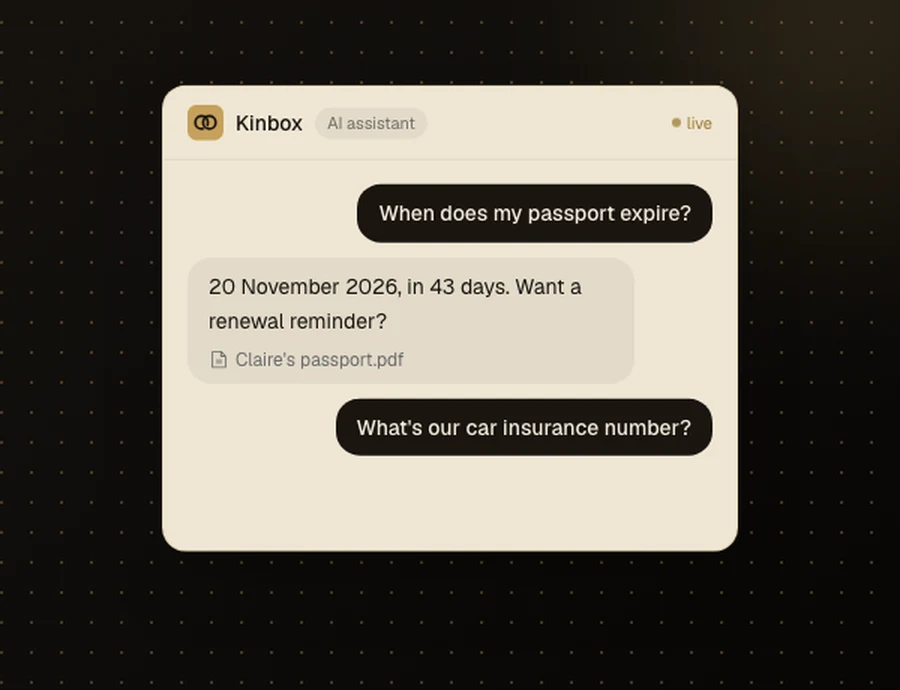
Kinbox, our own product. The answer names the document it came from.

AI Assistants

AI assistants help people find information, understand documents, and complete knowledge-based tasks through natural conversation.

They can be connected to company websites, internal documents, knowledge bases, and other approved information sources.

What they can do:

  • Answer questions using an organization's available knowledge.
  • Retrieve relevant information from documents and connected sources.
  • Provide references or links to supporting information when available.
  • Help users navigate services, policies, products, and procedures.
  • Acknowledge when information is unavailable rather than inventing an answer.

Examples:

  • Zephyr: CognivexAI's website assistant, designed to answer questions about the company, its services, and its capabilities.
  • Kinbox: An AI-powered document vault that supports natural-language retrieval from privately stored documents.
  • HR System Assistant: An assistant being developed to help users understand HR policies and French employment-law information using relevant source material.

Important distinction: An AI assistant primarily provides information and guidance. It does not automatically have permission to perform actions in external systems.
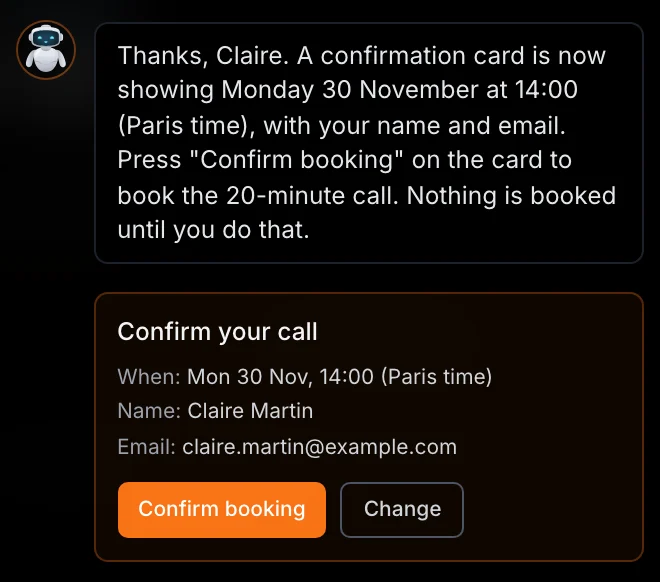
Zephyr, on this site, prepares the booking. Nothing is booked until the visitor presses Confirm.

AI Agents & Agentic Workflows

AI agents go beyond answering questions. They can interpret a request, decide which approved tools to use, and execute tasks through connected systems.

Depending on the implementation, an agent can interact with APIs, calendars, business applications, databases, and automation platforms.

What they can do:

  • Interpret user requests and identify the required steps.
  • Retrieve information from approved tools and systems.
  • Execute permitted actions through APIs or integrations.
  • Coordinate multi-step workflows.
  • Request human confirmation before important or irreversible actions.
  • Report what was completed and where further approval is required.

Examples:

  • Zephyr: Can prepare a calendar booking workflow, with the visitor confirming the action before it is finalized.
  • HR System: Can prepare a leave request and submit it for the appropriate approval process, with manager approval where required.

Our approach: We design agents around controlled permissions, clear action boundaries, verification, and human oversight. An agent should not be given unrestricted access simply because it can use a tool.

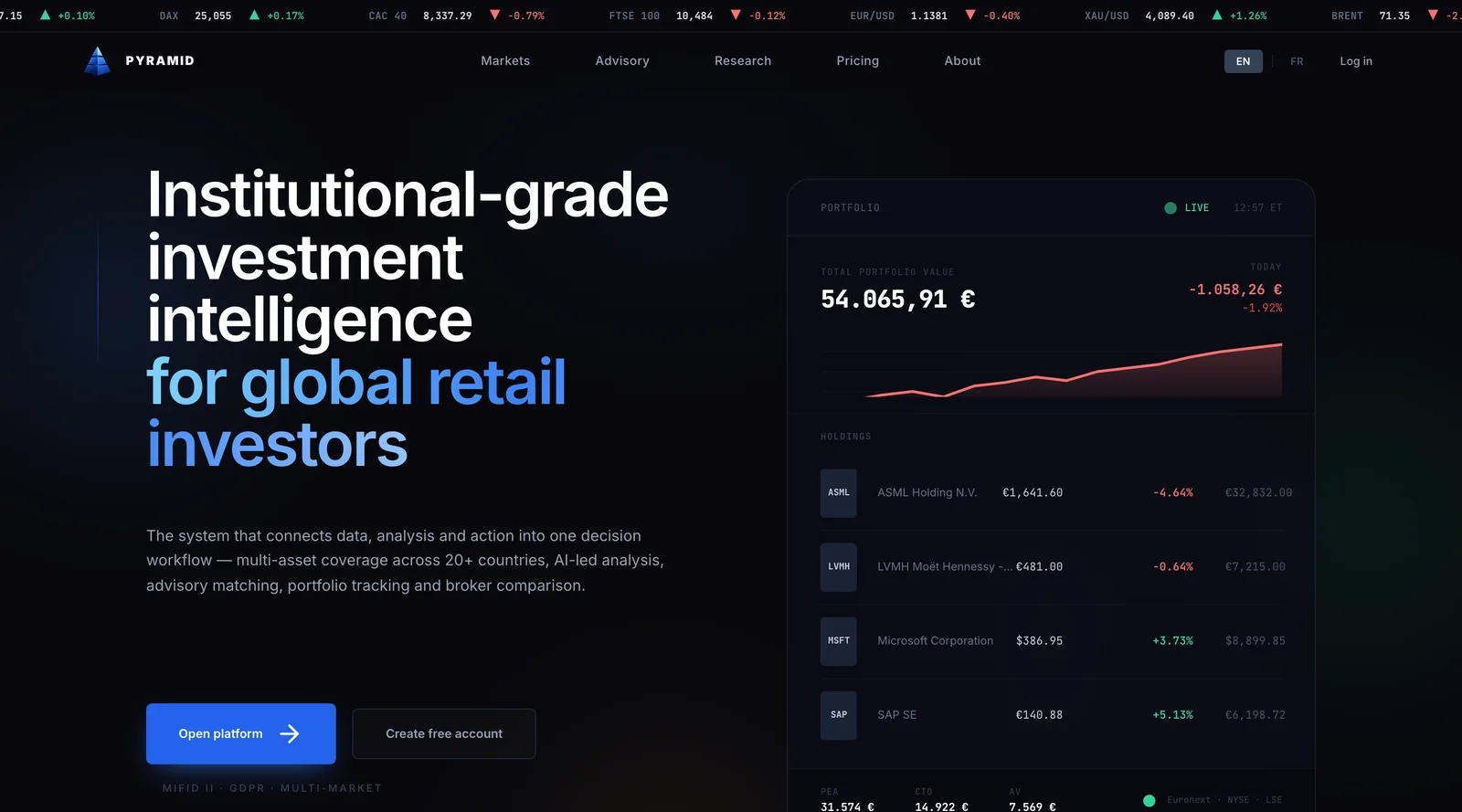
Pyramid Finance, a client project: market data, portfolio tracking and AI analysis.

Web Applications, SaaS & Websites

We design and develop web-based software, from business websites to data-intensive SaaS applications.

Our work covers frontend interfaces, backend services, databases, APIs, authentication, third-party integrations, and deployment.

What we build:

  • Custom business websites and web applications.
  • SaaS platforms and subscription-based products.
  • Data-intensive dashboards and analytical platforms.
  • AI-powered applications.
  • Authentication and user-management systems.
  • API integrations and backend services.
  • Responsive, installable Progressive Web Apps (PWAs).

Selected work:

Pyramid Finance — Client Project

An investment research platform that brings together financial information, analytical tools, portfolio tracking, and AI-assisted investment analysis.

The platform includes:

  • Financial data and market information.
  • Investment research and analytical tools.
  • Portfolio tracking.
  • AI-powered analysis.
  • Stripe-based subscription functionality.
  • A bilingual user experience.
  • An installable web application.

Website: https://pyramidfinance.eu/

Kinbox — CognivexAI Product

A private document vault designed around secure document storage and natural-language information retrieval. It explores how AI can make stored documents easier to search and understand.

Websites for Clients

CognivexAI also designs and develops websites tailored to individual client requirements, with attention to usability, performance, and maintainability.

FormWebhookAIEmailSheet

Business Process Automation

We connect applications, APIs, and business workflows to reduce repetitive manual work.

Our automation work includes tools such as n8n, webhooks, APIs, and integrations with business platforms.

What we can automate:

  • Data movement between applications.
  • Form submissions and notification workflows.
  • Document and content processing.
  • Email and communication workflows.
  • Social media content pipelines.
  • Repetitive administrative tasks.
  • Multi-step workflows involving AI services.

Example:

CognivexAI has explored an automated content pipeline that connects incoming content, AI-based processing, and content-generation services to produce marketing assets.

Automation requirements are assessed individually because each business has different applications, permissions, and workflow constraints.

PushTestsDeployEU

Cloud Infrastructure & DevOps

We help design and deploy the infrastructure required to operate web applications and AI-powered systems.

Depending on the project, our work may involve:

  • Cloud architecture and deployment.
  • Application hosting.
  • Docker-based environments.
  • CI/CD pipelines.
  • GitHub Actions.
  • Environment and configuration management.
  • Monitoring and deployment workflows.
  • Database and API infrastructure.

Technologies and platforms used across our work include Vercel, Scaleway, OVH, AWS, Docker, and GitHub Actions.

CognivexAI also works with partner engineers on infrastructure requirements when a project calls for additional expertise.

EU-based hosting can be considered where data residency and deployment requirements make it appropriate.

12 of 12attacks blockedAllowed action

AI Security & Reliability

AI systems introduce risks that traditional application testing alone cannot address. These include prompt injection, unauthorized tool usage, unreliable retrieval, sensitive-data exposure, and unsupported answers.

CognivexAI considers security and reliability during the design, implementation, and testing of AI-powered applications.

Our security and reliability work can include:

  • Mapping data flows and identifying sensitive information.
  • Reviewing access permissions and tool boundaries.
  • Implementing input validation and filtering.
  • Applying least-privilege access principles.
  • Requiring human approval for sensitive actions.
  • Evaluating answer quality and source grounding.
  • Testing prompt-injection and other adversarial scenarios.
  • Creating automated evaluations and regression tests.
  • Documenting findings and providing a technical handover.

Example — Zephyr Security Testing

During an initial red-team testing round, a weakness was identified and subsequently addressed in the implementation. A second round tested 12 attack scenarios, with all 12 blocked on the live website.

This is a result from a specific testing exercise, not a guarantee that every possible attack or vulnerability has been eliminated.

Our objective is to make AI systems more controlled, testable, and dependable—not to claim that any system is completely secure.

How We Approach Projects

We begin by understanding the actual problem rather than assuming that AI is always the answer.

A typical engagement follows these stages:

  1. 01

    Discovery

    Understand the business requirement, users, existing systems, constraints, and expected outcomes.

  2. 02

    Solution Design

    Determine whether the problem requires a conventional application, an AI assistant, an AI agent, automation, or a combination of these.

  3. 03

    Architecture & Planning

    Define the technical architecture, data sources, integrations, permissions, infrastructure, and implementation approach.

  4. 04

    Development

    Build the solution in manageable stages, with appropriate testing and validation.

  5. 05

    Evaluation & Quality Assurance

    Test application functionality, integrations, security boundaries, and—where AI is involved—retrieval quality, answer accuracy, and expected agent behavior.

  6. 06

    Deployment & Handover

    Deploy the application, configure the required infrastructure, and provide the agreed technical handover.

  7. 07

    Improvements & Maintenance

    Further support, monitoring, enhancements, and maintenance can be discussed according to the project agreement.

What CognivexAI Can and Cannot Do

Capabilities

CognivexAI can develop:

  • AI assistants connected to approved knowledge sources.
  • AI agents that interact with approved tools and APIs.
  • Custom web applications and SaaS platforms.
  • Document retrieval and AI-powered search systems.
  • Business process automation.
  • Cloud deployment and DevOps workflows.
  • AI security testing and evaluation workflows.

The exact solution depends on the requirements, available data, integrations, infrastructure, and project scope.

Important Limitations

Native mobile applications

CognivexAI's current web application approach includes Progressive Web Apps (PWAs), which can be installed on supported devices. A PWA should not be described as a native iOS or Android application.

WhatsApp integrations

WhatsApp integrations may be possible through supported APIs and webhooks. Availability and scope depend on the business account, provider requirements, permissions, and intended workflow. Do not promise an integration before assessing it.

Shopify integrations

An AI assistant can be integrated into a Shopify storefront through an appropriate website widget or script-based integration. The exact capabilities depend on the available APIs and permissions.

External systems

An integration should never be assumed to exist. First establish which platform is involved, whether it provides a suitable API, and what access is available.

AI accuracy

AI-generated responses are not guaranteed to be correct. For important workflows, source verification, validation, approval, and escalation mechanisms should be considered.

Legal and regulatory information

AI systems can help retrieve and explain information from legal and regulatory sources. They should not be represented as a substitute for qualified legal advice or as a guarantee of legal compliance.

Security

Security testing reduces risk but cannot prove that a system is completely secure. Any security claim must be limited to the scope and results of the actual assessment.

Frequently Asked Questions

Can CognivexAI build a custom AI assistant for my business?

Yes. CognivexAI can develop AI assistants connected to suitable business documents, websites, knowledge bases, and approved data sources. The architecture depends on the information sources, expected usage, and security requirements.

Can you build an AI agent that performs tasks?

Yes. CognivexAI can develop agents that use approved tools and integrations to execute workflows. Sensitive actions can be designed to require human confirmation or approval.

What is the difference between an AI assistant and an AI agent?

An assistant primarily provides information and guidance. An agent can use approved tools to perform tasks and coordinate workflows. Some systems combine both approaches.

Can you build a complete SaaS product?

Yes. CognivexAI works on end-to-end web application development, including frontend, backend, databases, authentication, APIs, AI capabilities, and deployment.

Can you integrate AI into our existing software?

Potentially, yes. This depends on the existing software, its APIs, access permissions, and the required workflow. A technical assessment is needed before confirming feasibility.

Can you automate our business processes?

Yes. CognivexAI can assess repetitive workflows and develop automation using APIs, webhooks, n8n, and other suitable technologies.

Can you build a mobile application?

CognivexAI currently develops responsive web applications and installable PWAs. Native iOS and Android development should not be assumed to be part of the standard offering.

Can you integrate an AI assistant with WhatsApp?

This may be possible through supported WhatsApp APIs and integrations. The requirements and feasibility need to be assessed first.

Can you make an AI assistant answer only from our documents?

An assistant can be designed to retrieve answers from specified knowledge sources, provide supporting references where available, and abstain when sufficient information cannot be found. The exact level of control depends on the retrieval and evaluation architecture.

Do you provide AI security testing?

CognivexAI can assess AI application security and reliability through measures such as access-control reviews, prompt-injection testing, input validation, and AI evaluations. The scope and deliverables depend on the engagement.

How much does a project cost?

Pricing depends on the project scope, complexity, integrations, infrastructure, and delivery requirements.

How long does development take?

Timelines depend on requirements, technical complexity, integrations, and testing. A realistic estimate can be provided after understanding the scope.

Contact

For project discussions, technical assessments, or business inquiries:

First step: a 20-minute call, which you can book from the chat or the contact page.

Website: https://cognivexai.eu/

Email: mugesh@cognivexai.eu

Visitors should share a brief description of their business problem, expected outcome, and any relevant existing systems. CognivexAI can then assess the requirements and recommend an appropriate approach.

Zephyr Here!

    CognivexAI

    ©